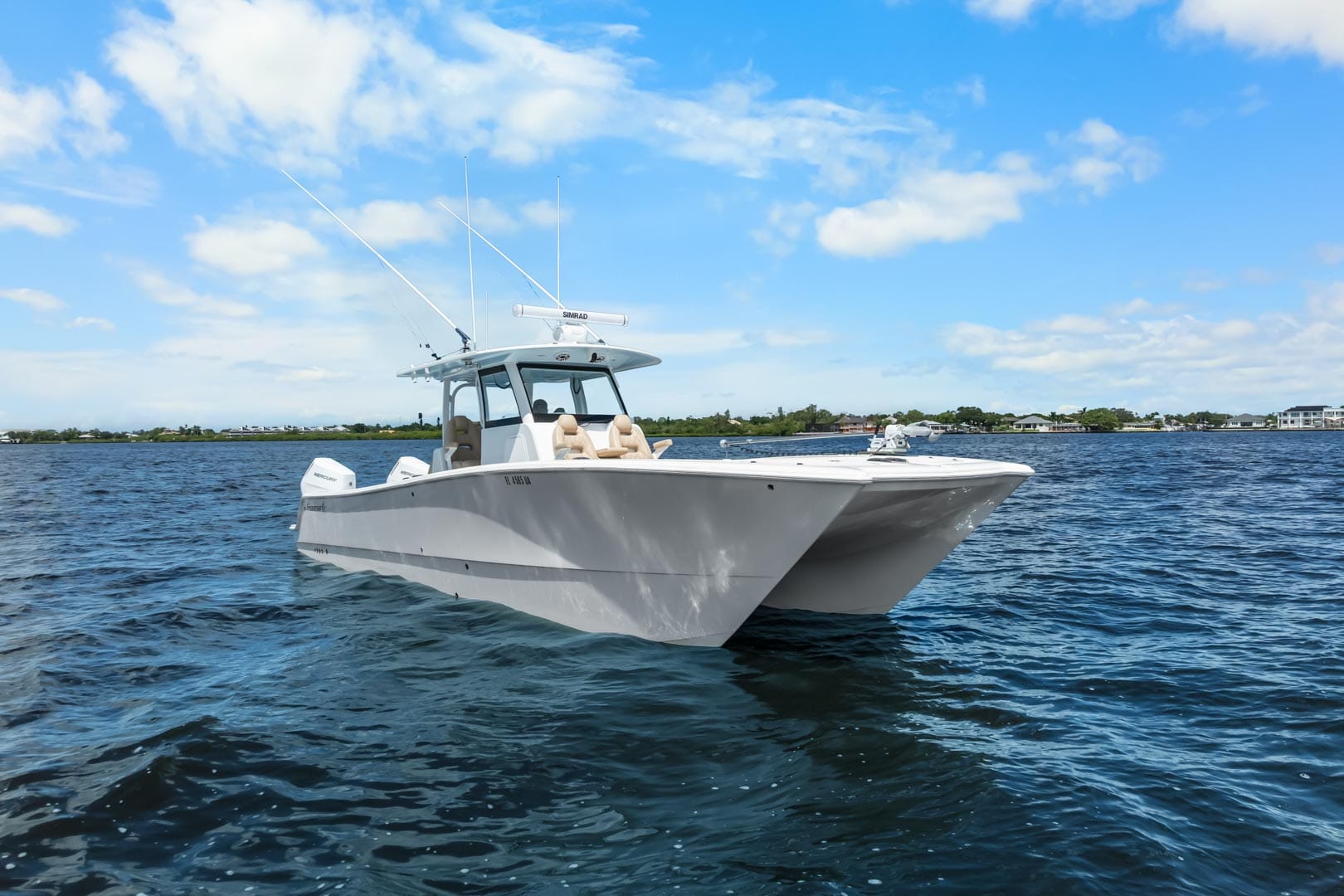
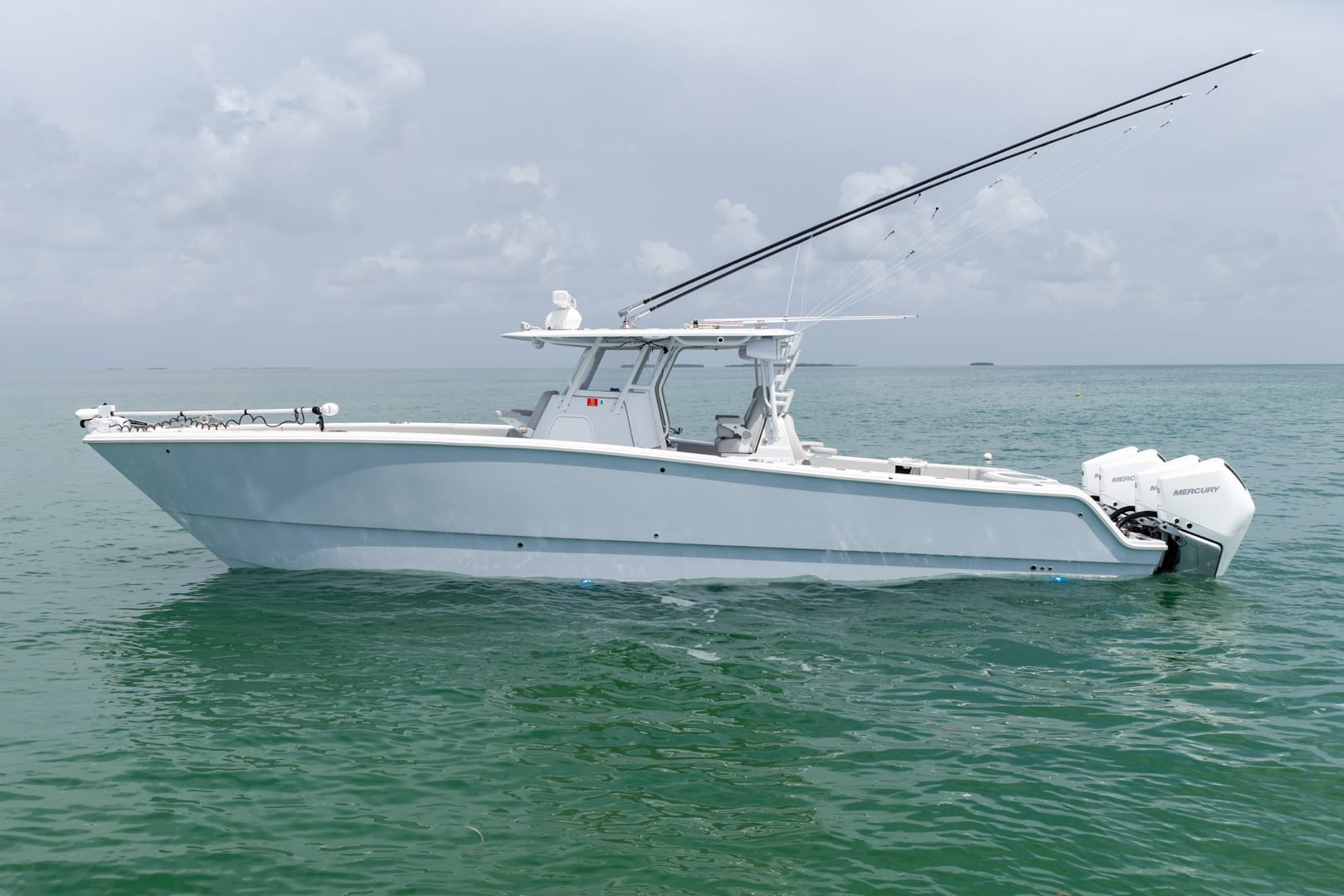
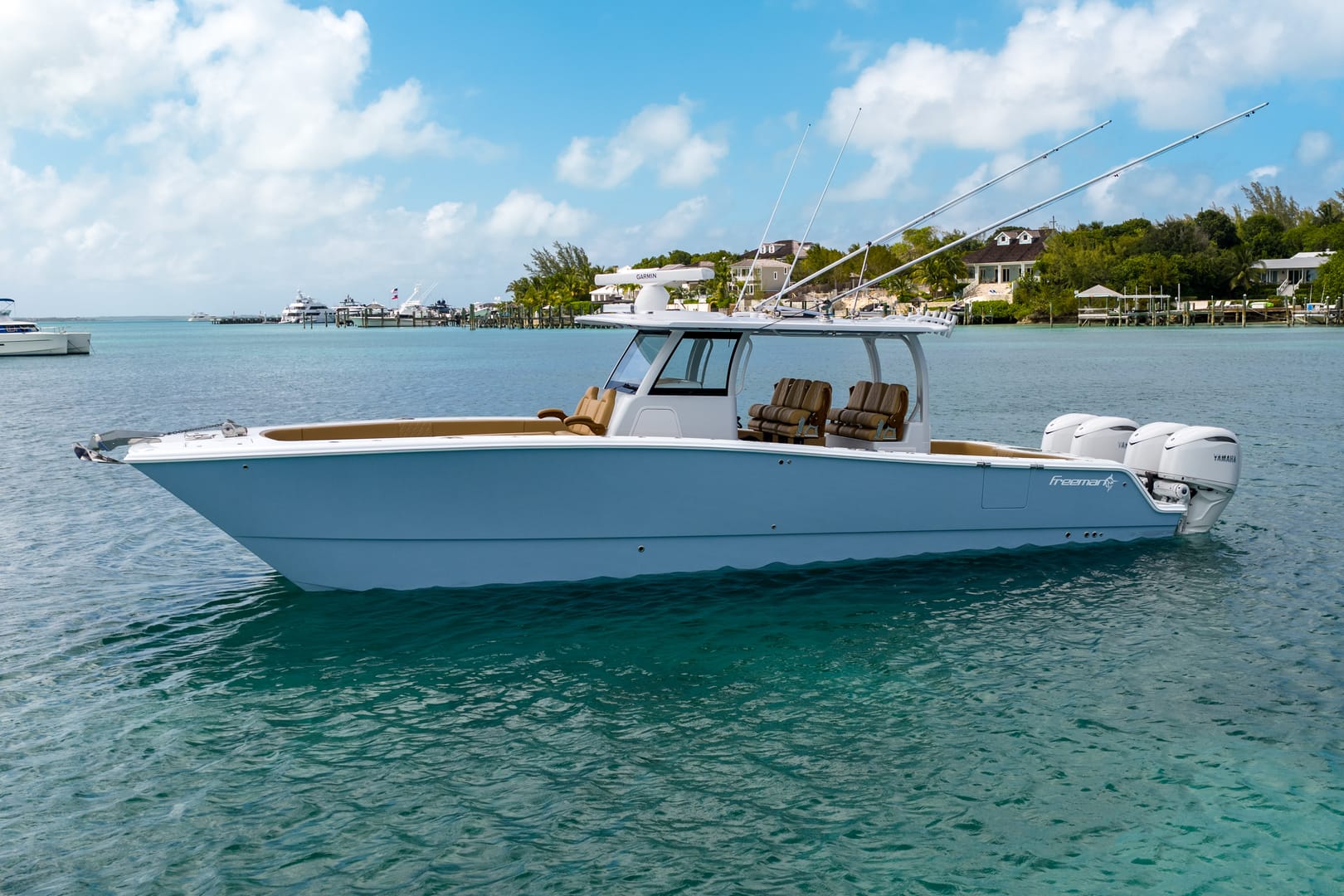
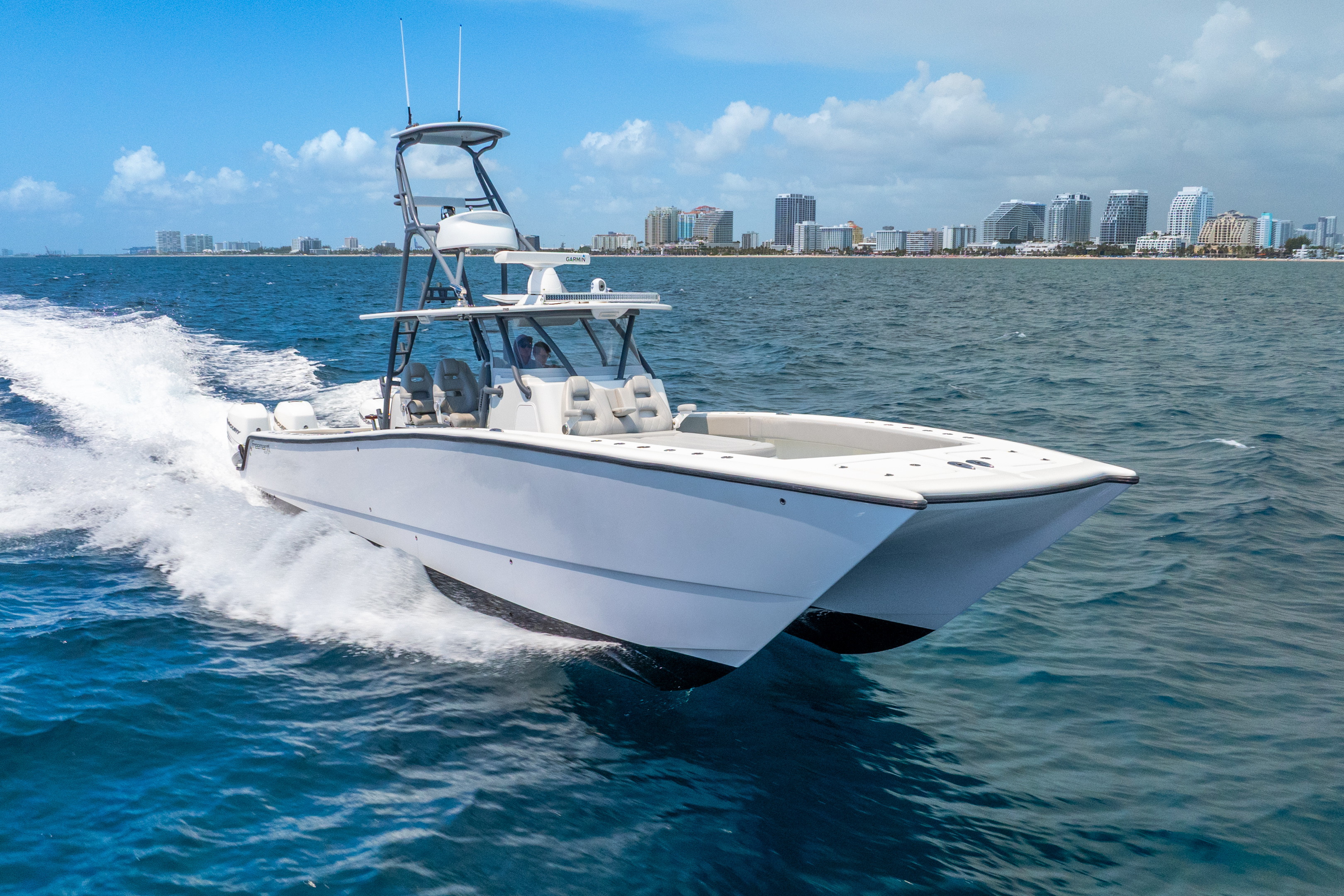
Walk through almost any marina in South Florida and you'll notice something about modern center console boats: two outboard engines are no longer necessarily enough. Triple-engine setups are common on larger offshore boats, while some high-performance center consoles carry four or even five outboards across the transom.
But does adding a third engine actually make a boat better?
For some owners, absolutely. Triple outboards can provide stronger acceleration, additional horsepower, improved performance under heavy loads, and another engine to rely on if one fails offshore. For others, the third engine adds purchase costs, maintenance expenses, fuel consumption, and weight without delivering much practical benefit.
The answer depends on the boat, the engines, and how the owner intends to use it.
Here's how twin and triple outboard configurations compare in real-world boating, including the differences in speed, fuel economy, reliability, maintenance, and long-term ownership costs.
Twin vs. Triple Outboards: What's the Difference?
A twin-outboard boat uses two engines mounted on the transom, while a triple-outboard configuration uses three.
The most obvious difference is available horsepower. For example, a center console equipped with twin 300-horsepower outboards has 600 total horsepower. Adding a third identical engine increases the combined output to 900 horsepower.
That represents a 50% increase in installed horsepower, but it does not mean the boat will travel 50% faster.
Boat speed is influenced by hull design, displacement, propeller selection, engine mounting height, weight distribution, and hydrodynamic drag. As speed increases, substantially more power is generally required to overcome resistance.
There's also the additional weight of the third engine, which affects how the boat sits in the water and how efficiently it operates.
For a hull specifically designed to accommodate three outboards, the additional power may deliver excellent performance. On a hull optimized for twins, however, installing a third engine may create more problems than benefits.
Twin vs. Triple Outboards: Quick Comparison
| Category | Twin Outboards | Triple Outboards |
|---|---|---|
| Initial engine cost | Lower | Higher |
| Available horsepower | Lower with identical engines | 50% more with three identical engines |
| Acceleration | Good when properly matched | Potentially stronger under load |
| Top speed | Depends on total horsepower and hull | Often higher with greater total horsepower |
| Fuel consumption | Often lower at comparable operating loads | Higher at full throttle with identical engines |
| Routine maintenance | Two engines to service | Three engines to service |
| Engine redundancy | One remaining engine after a failure | Two remaining engines after a failure |
| Transom weight | Generally lower | Generally higher |
| Best suited for | Many recreational and offshore boats | Larger or heavier performance-oriented boats |
These comparisons assume engines of similar size and output. A boat with twin 450-horsepower engines may behave very differently from one with triple 300s, even though both configurations produce 900 total horsepower.
Are Triple Outboards Faster Than Twins?
Triple outboards are often faster than twins when the additional engine increases total horsepower and the hull is designed to handle that power.
However, comparing the number of engines without considering total horsepower can be misleading.
Consider three hypothetical configurations:
- Twin 300 HP outboards: 600 total horsepower.
- Triple 300 HP outboards: 900 total horsepower.
- Twin 450 HP outboards: 900 total horsepower.
The triple 300 configuration has substantially more horsepower than the twin 300 setup, so it may offer stronger acceleration and a higher top speed on an appropriate hull.
But comparing triple 300s with twin 450s is more complicated. Both configurations deliver the same rated total horsepower, yet they differ in weight, gearcase drag, propeller characteristics, torque delivery, and how the power is distributed across the transom.
One configuration may accelerate more quickly, while the other may achieve a better top speed or cruising efficiency.
Engine count alone cannot determine the winner.
Why More Horsepower Doesn't Mean Proportionally More Speed
As a boat accelerates, the relationship between horsepower and speed becomes increasingly demanding.
Once a planing hull reaches higher speeds, overcoming additional drag requires significantly more power.
That's why increasing installed horsepower by 50% rarely produces a corresponding 50% increase in maximum speed.
The exact improvement depends on the hull and its operating characteristics. Manufacturer performance bulletins and properly conducted sea trials are much more useful than simple horsepower calculations.
Do Triple Outboards Burn More Fuel?
Fuel consumption is one of the biggest considerations when deciding between twin and triple outboards.
Three identical engines operating at full throttle will generally consume more fuel in total than two identical engines operating at full throttle.
However, that doesn't automatically mean triple outboards are less efficient at every cruising speed.
There are two different measurements owners should understand:
- Gallons per hour (GPH): How much fuel the boat burns over time.
- Miles per gallon (MPG): How far the boat travels for each gallon consumed.
For example, consider two hypothetical boats traveling at the same speed of 35 mph.
| Configuration | Speed | Total fuel burn | Fuel economy |
|---|---|---|---|
| Twin outboards | 35 mph | 28 GPH | 1.25 MPG |
| Triple outboards | 35 mph | 33 GPH | 1.06 MPG |
These numbers are illustrative examples, not measured results from a particular boat or engine package.
In this scenario, the twin-engine boat is more fuel-efficient at the same speed.
But on a larger, heavier hull, a triple-engine configuration might allow each engine to operate at a more favorable load while maintaining the desired cruising speed.
Depending on the engine models and hull design, that could narrow the efficiency difference or occasionally favor the triple-engine arrangement.
The most meaningful comparison is fuel economy at the same speed, with similar loading and sea conditions.
How Much More Does a Third Outboard Cost in Fuel?
Using the hypothetical example above, the triple-engine boat consumes five additional gallons per hour at 35 mph.
Over 100 hours of cruising at that operating point, the difference would be 500 gallons.
At an illustrative fuel price of $4 per gallon, that's an additional $2,000 in fuel expenses.
Actual costs could be substantially different. Fuel prices vary by marina, and boats rarely operate at one fixed speed or engine load for an entire season.
Still, this illustrates why even a relatively small difference in fuel economy can become significant for owners who use their boats frequently.
Are Triple Outboards More Reliable Offshore?
One of the strongest arguments for triple outboards is redundancy.
If one engine fails on a twin-engine boat, the owner has one remaining engine available.
If one engine fails on a triple-engine boat, two engines remain operational.
That can be a meaningful advantage when traveling long distances offshore.
For example, a center console returning from a fishing trip 60 miles offshore may be better positioned to continue toward port if it loses one of three engines rather than one of two.
However, there are important limitations.
Three engines do not guarantee that the boat will remain on plane after an engine failure. Depending on the hull, load, and remaining horsepower, the vessel may need to return at displacement speed.
Some failures can also affect multiple engines simultaneously.
Contaminated fuel, electrical problems, cooling-water restrictions, or damage involving shared systems can disable more than one engine.
Having three engines also means having three sets of mechanical components that can experience individual failures.
The benefit is additional propulsion redundancy, not immunity from breakdowns.
Does a Third Engine Make Offshore Boating Safer?
It can improve the options available after certain engine failures, but engine redundancy is only one part of offshore safety.
A properly maintained twin-engine boat with adequate fuel reserves, reliable communications equipment, and a competent captain may be better prepared than a poorly maintained triple-engine boat.
For offshore trips, owners should also consider an EPIRB or personal locator beacon, appropriate life jackets, VHF communications, weather monitoring, and a documented float plan.
Engine count should never replace proper trip planning or maintenance.
How Much More Does It Cost to Maintain Triple Outboards?
Maintenance is where the financial differences become particularly noticeable.
A third engine means another complete propulsion system requiring routine service and eventual repairs.
Depending on the engine model and service interval, maintenance may include engine oil, filters, gearcase lubricant, spark plugs, water pumps, thermostats, anodes, and other manufacturer-specified items.
There are also additional propellers, controls, steering components, and rigging-related systems to consider.
For a simple illustration, assume routine annual engine servicing costs $800 per outboard.
| Configuration | Illustrative annual engine service cost |
|---|---|
| Twin outboards | $1,600 |
| Triple outboards | $2,400 |
| Additional cost for third engine | $800 |
These are hypothetical service costs, not current quotes from a marine service provider. Actual pricing depends on the engine, location, service scope, and labor rates.
Major scheduled maintenance and unexpected repairs can make the difference considerably larger.
Over ten years of ownership, the cost of maintaining an additional outboard can add up to thousands of dollars, even before accounting for major component replacements.
How Much Does a Third Outboard Engine Cost?
The initial purchase price is another major factor.
Modern high-horsepower outboards can cost tens of thousands of dollars each, depending on the manufacturer, horsepower rating, rigging package, and dealer installation costs.
Adding a third engine involves more than purchasing the engine itself.
The complete installation may require additional steering components, controls, propellers, mounting hardware, wiring, fuel-system components, and labor.
On a new boat, manufacturers may package these costs into the overall propulsion upgrade.
For an existing boat, converting from twins to triples can be considerably more complicated.
The transom must be designed and rated for the additional weight and horsepower, and the engine mounting positions must be appropriate for the hull.
In many cases, repowering with a more powerful twin-engine package is a more practical option than modifying a boat to accommodate three engines.
Are Triple Outboards Better for Heavy Boats?
Large center consoles often carry substantial weight.
A fully equipped offshore boat may have hundreds of gallons of fuel, freshwater, ice, fishing equipment, electronics, passengers, and supplies aboard.
That additional load affects acceleration and the amount of power required to get the hull onto plane.
On a heavy boat designed for triple outboards, the additional horsepower can make a noticeable difference when accelerating with a full load.
It may also allow the boat to maintain its preferred cruising speed without operating the engines as close to their maximum output.
But the relationship isn't universal.
A lighter, efficiently designed hull may perform exceptionally well with twins, while a larger boat with a different running surface may require three or four engines to achieve its intended performance.
Matching the propulsion package to the hull matters more than choosing the largest number of engines available.
Does a Third Outboard Affect Handling?
Adding another engine changes the weight distribution and propulsion characteristics of a boat.
With three outboards, more weight is concentrated at the transom. This can influence static trim, planing behavior, and how the boat responds to waves.
Additional gearcases and propellers also affect drag and steering characteristics.
Modern integrated steering and joystick systems can make both twin- and triple-engine boats relatively easy to maneuver, particularly when the system is properly calibrated for the vessel.
However, a triple-engine setup is not automatically easier to dock.
Docking performance depends on the available control system, engine spacing, propeller configuration, windage, current, and operator experience.
For buyers, a sea trial that includes low-speed maneuvering is just as important as testing maximum speed.
Can You Run a Triple-Outboard Boat on Two Engines?
Many owners wonder whether they can save fuel by shutting down one engine while cruising.
The answer depends on the boat and the manufacturer's operating guidance.
Some multi-engine installations may allow limited operation with one engine shut down, but doing so can change steering behavior, propeller drag, and the load placed on the remaining engines.
On certain boats, running fewer engines may actually reduce overall efficiency because the remaining engines must work harder to maintain speed.
There can also be manufacturer-specific procedures for handling a stopped outboard while underway.
Owners should not assume that shutting off the center engine will automatically save one-third of their fuel consumption.
Before operating a triple-engine boat with fewer than three engines running, consult the boatbuilder's and engine manufacturer's instructions.
Twin 450s vs. Triple 300s: Which Is Better?
This is one of the more interesting comparisons because both configurations provide 900 total horsepower.
With twin 450s, the boat has two larger engines. With triple 300s, the same rated horsepower is distributed across three smaller engines.
The twin-engine setup may offer advantages in reduced gearcase drag, fewer service items, and potentially lower transom weight, depending on the actual engine models.
The triple-engine arrangement offers an additional source of propulsion if one engine fails and may provide different acceleration characteristics due to its propeller arrangement.
However, the third engine also introduces more mechanical complexity and additional maintenance.
There is no universal winner.
The better configuration depends on the specific hull, the weight and dimensions of the engines, propeller selection, and the manufacturer's performance testing.
When comparing two boats with the same total horsepower, look at measured cruising speed, fuel economy, acceleration, handling, and actual engine weight rather than horsepower alone.
What Size Boat Needs Triple Outboards?
There is no specific boat length at which three outboards become necessary.
Some 30-foot center consoles are available with triple engines, while certain larger boats operate successfully with twins.
As a general market observation, triple outboards become more common on performance-oriented center consoles in roughly the mid-30-foot to 40-foot range and above.
But length is only one factor.
A heavy 35-foot boat with a deep-V hull and extensive equipment may have very different power requirements from a lighter 35-foot boat designed for efficiency.
Owners should consider the manufacturer's recommended engine packages, maximum rated horsepower, transom capacity, and verified performance results.
A boat should never be fitted with additional engines or horsepower beyond its approved design limits.
When Are Twin Outboards the Better Choice?
Twin outboards are often the more practical choice for owners who prioritize manageable operating costs and do not need the additional horsepower of a triple-engine setup.
They can be particularly attractive when:
- The boat already achieves its desired cruising and top speeds with twins.
- Fuel efficiency is more important than maximum performance.
- The owner wants lower routine maintenance costs.
- The boat is primarily used for recreational cruising and occasional offshore fishing.
- The hull was designed and optimized for twin engines.
A properly matched twin-engine setup can provide excellent performance, maneuverability, and offshore capability without the expense of maintaining a third outboard.
When Are Triple Outboards Worth It?
Triple outboards become more compelling when the boat is large or heavily loaded, when additional horsepower produces a meaningful performance improvement, or when propulsion redundancy is a major priority.
They may be worth considering when:
- The hull is specifically designed for triple engines.
- The boat regularly carries substantial fuel, passengers, and equipment.
- Stronger acceleration and higher cruising speeds are important.
- The owner frequently travels long distances offshore.
- The additional engine provides a meaningful operational advantage.
- The owner is comfortable with the higher purchase and maintenance costs.
For some offshore fishing owners, the performance and redundancy benefits justify the additional expense.
For others, a well-equipped twin-engine boat will accomplish the same trips at a lower total cost of ownership.
Frequently Asked Questions About Twin and Triple Outboards
Are three outboard engines better than two?
Not necessarily. Triple outboards can provide additional horsepower and propulsion redundancy, but they also increase weight, purchase costs, and maintenance requirements. The best configuration depends on the boat and its intended use.
Do triple outboards use 50% more fuel?
Not automatically. Three identical engines at similar loads may consume roughly 50% more fuel than two, but actual boat-level consumption depends on speed, hull efficiency, engine loading, and other factors. Fuel economy should be compared at the same boat speed.
Are triple outboards safer offshore?
They provide an additional engine in the event of certain failures, but they do not eliminate the risk of breakdowns. Shared fuel or electrical problems can affect multiple engines, and proper safety equipment remains essential.
Can a triple-engine boat run on two engines?
Some boats can operate with one engine disabled, but the appropriate procedure depends on the vessel and engine manufacturer. Performance and handling may be significantly affected.
Is it cheaper to maintain twin outboards?
Generally, yes. Twin outboards have fewer engines requiring scheduled maintenance, replacement parts, and repairs. Actual savings depend on the engine models and service requirements.
Are twin 450s better than triple 300s?
Both configurations provide 900 total horsepower, but their performance can differ substantially. Twin 450s may offer advantages in simplicity and drag, while triple 300s provide an additional engine for redundancy. The better choice depends on the hull and verified performance data.
Final Verdict: Is the Third Outboard Worth the Money?
For most boat owners, the decision between twin and triple outboards should begin with a simple question: What does the third engine actually improve?
If adding another engine produces noticeably better acceleration, allows the boat to maintain its intended cruising speed under heavy loads, or provides valuable redundancy for frequent offshore trips, the additional expense may be justified.
But if a twin-engine configuration already delivers the performance an owner needs, the third engine may simply add weight, maintenance, and operating costs.
The number of outboards across the transom is not a reliable measure of how good a boat is.
A properly designed and powered twin-engine center console can outperform a poorly matched triple-engine boat in the areas that matter most to its owner.
Before choosing, compare manufacturer performance reports, calculate realistic ownership costs, and sea-trial the configurations whenever possible.
Ultimately, the best engine setup is the one that delivers the right balance of performance, efficiency, reliability, and cost for the way the boat will actually be used.
For more information about offshore performance and boat ownership, explore our guides on how far a center console can go offshore and what is considered high hours on a boat engine.
Follow Boats Daily for more center console comparisons, outboard engine guides, and practical advice for boat owners.